

CE and RoHS Requirements: Electrical Products Buyer Guide
Leave a message
CE and RoHS Requirements for Electrical Products
CE and RoHS requirements for electrical products should be reviewed before you approve a bulk order. A supplier may send a certificate image, yet leave an important purchasing question unanswered: does the supporting documentation cover the exact switch or socket you intend to import?
For distributors and OEM buyers, the review should connect the destination country, product model, electrical rating and final configuration. A report for another series, an incomplete model list or an undocumented material change can leave questions unresolved when production is already underway.
For example, imagine receiving switch documentation while your purchase order lists socket outlets. That mismatch calls for clarification before approval; it does not establish whether the products themselves are safe or compliant. This guide explains how to resolve such questions for wall switches, sockets and plugs.
What CE Marking and RoHS Compliance Mean for Buyers
CE marking indicates that a product conforms to the applicable EU legislation requiring that marking. The manufacturer is responsible for the conformity assessment, technical documentation and EU Declaration of Conformity-a signed statement identifying the product and the legislation it meets. CE is not a general quality award or approval issued by a central EU certification office.
Buyers searching for a CE certified switch supplier should therefore ask what documents support the proposed model. A third-party test report can provide evidence about tested samples; it does not replace the manufacturer's responsibilities.
RoHS restricts hazardous substances in electrical and electronic equipment within its scope. EU RoHS currently restricts ten substances, including lead, cadmium and certain flame retardants and plasticisers. Where RoHS applies, it is part of the product's CE compliance obligations, rather than an unrelated quality badge.
Start with the Product Type and Destination Market
"Electrical accessories" is too broad a description for a compliance review. Begin with the exact product and intended use.
For a wall switch, identify its operating principle, voltage and current rating, and any electronic functions. A mechanical switch and a switch incorporating electronic controls should not automatically receive the same document checklist.
There is an important distinction for domestic plugs and socket outlets: these are excluded from the EU Low Voltage Directive. This exclusion does not establish that they have no other obligations or can never require CE marking. Other applicable legislation, including RoHS where relevant, and destination-country requirements still need assessment.
When comparing Wall Switches and Sockets or sourcing Plugs, send the supplier a model list rather than asking whether the entire catalogue is "CE approved."
|
Product information to specify |
Why it matters |
|
Exact model and intended use |
Establishes which product is being assessed |
|
Rated voltage and current |
Allows comparison with the supporting documents |
|
Mechanical or electronic operation |
Helps identify relevant regulatory and testing questions |
|
Domestic plug or socket configuration |
Flags the need to check the appropriate product rules |
|
Destination country |
Identifies the market requirements to review |
Treat an indicator lamp, electronic control or additional connection feature as information to disclose. Let the product assessment establish its significance instead of assuming that a visually similar model has identical requirements.
Five Checks for Reviewing Supplier Compliance Documents
When evaluating a CE certified switch supplier, review these five areas together. They are a purchasing checklist, not a rule that every product must have five separate certificates.
Match the product specification and model coverage
Compare the quotation, proposed sample and document model lists. Record the exact model, voltage, current, function and any options that distinguish it from the tested configuration.
For example, if you order a two-gang switch but receive a report describing a one-gang model, ask how the ordered variant is covered. Request the relevant appendix or technical explanation rather than assuming similar appearance establishes coverage.
Use a simple order record with one row per model and columns for its rating, configuration, document reference and unresolved questions. This prevents a certificate for one product line from being carried across to another without review.
Review the EU Declaration of Conformity
For products subject to EU CE marking requirements, request the applicable signed declaration. Check the identified product, responsible manufacturer, applicable legislation, referenced standards or other technical specifications, and signature details.
Third-party attestations can be supplementary records, but a voluntary certificate does not replace the required conformity assessment and declaration. Confirm unclear document references through the issuing organisation's official verification channel.
An unfamiliar address or model code deserves an explanation. Ask how the legal entity and product identifiers relate to the goods being supplied; do not judge authenticity from a logo alone.
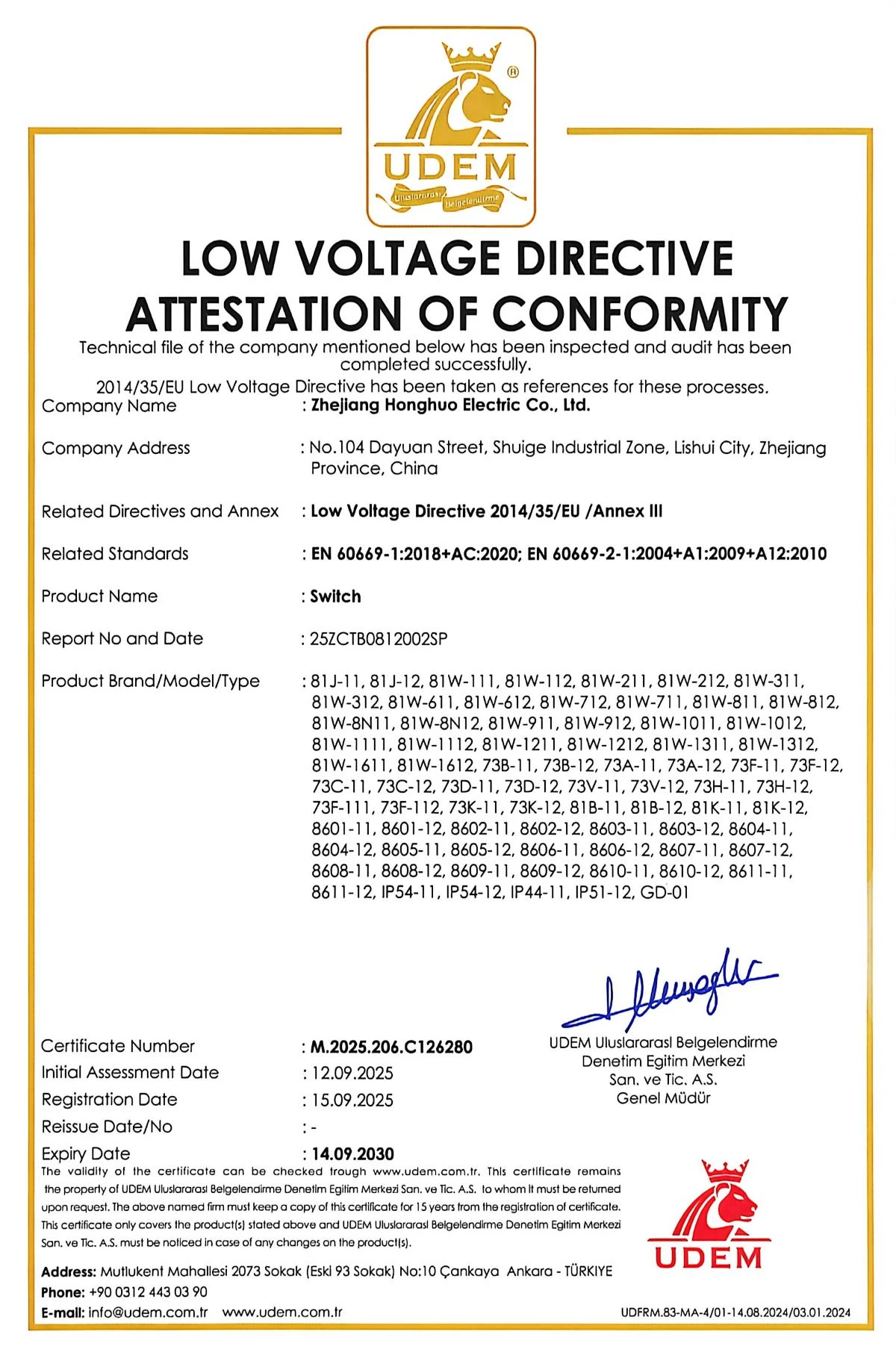
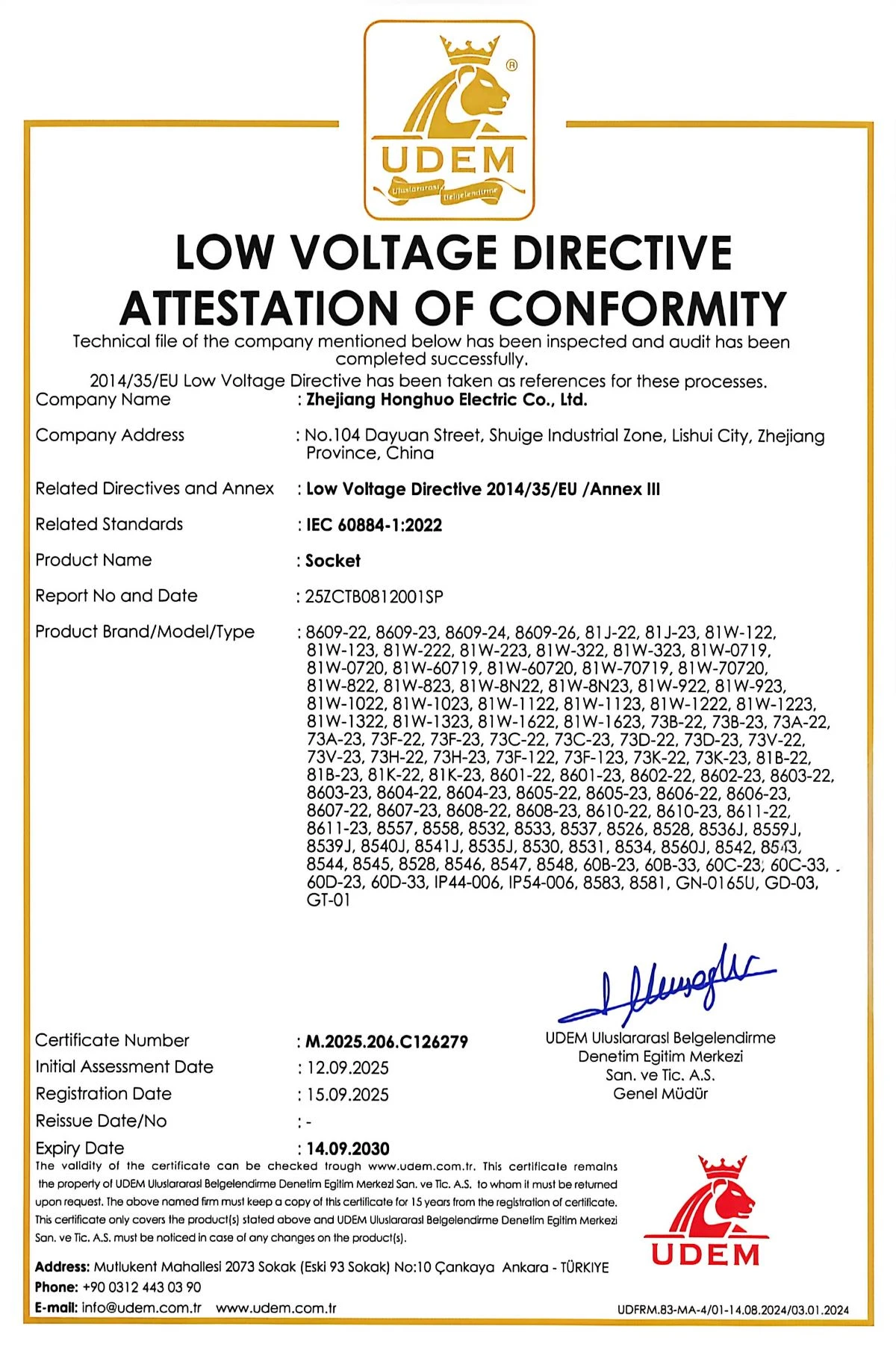
Check reports supporting the claimed performance
A test report describes a sample, test scope and results. Check the sample identification, rating, standard edition and relevant construction details. Ask whether the cited edition remains appropriate for the intended market; an older date alone does not prove non-compliance.
Electrical safety and ingress protection address different risks. If you order Waterproof Switches with a specified IP rating, review the corresponding evidence and installation conditions separately. An IP report cannot establish restricted-substance compliance or suitability for every outdoor location.
Review the basis for RoHS compliance
When sourcing RoHS compliant electrical products, ask how the evidence covers the supplied model and materials. Depending on the assessment, it may include supplier declarations, material information and test results. A laboratory report is useful evidence, but it is not the only possible basis for documenting compliance.
A result for the plastic housing should not be assumed to cover terminals, coatings or other parts of the finished assembly. Check the scope of declarations and any exemptions cited. If a material or component has changed, ask whether the supporting assessment has been updated.
Check controls for continuing production
Ask how the manufacturer maintains the approved specification through purchasing, assembly and later component substitutions. Relevant information can include material controls, inspection records and change approval procedures.
ISO 9001 concerns the manufacturer's quality management system. It supports a review of production controls, but it does not certify each switch or socket or replace product-specific evidence. Similarly, inspecting every finished unit does not mean every unit undergoes every laboratory test.
Managing OEM Changes and Avoidable Compliance Costs
An OEM order should include a review of changes from the documented configuration. A new appearance can involve more than a cosmetic difference.
Consider three purchasing scenarios:
Different housing material: Replacing the specified plastic may affect the evidence supporting material compliance and relevant safety characteristics.
Changed metal component or finish: A new terminal material, coating or supplier may require a review of the corresponding material information.
Added function: Introducing an electronic feature can change the product configuration and the questions its assessment must address.
These are review triggers, not a claim that every change requires a complete new test programme. Ask the manufacturer to identify which existing evidence remains applicable and whether further assessment is needed.
Before placing a customized order, agree on the final specification, approved sample and process for accepting later substitutions. This gives purchasing and production teams a shared reference.
Use the OEM Service discussion to raise these questions while materials and features are still being selected. Reviewing changes early can help avoid paying for unnecessary repeat work or discovering missing evidence after packaging has been printed.
Agree which additional assessments are needed, who will arrange them and when the results must be available. If independent testing is appropriate, finalise the configuration before sending representative samples. Record the agreed documentation and change approvals in the purchasing specification; do not assume testing an earlier sample covers a later material substitution.
What Buyers in Saudi Arabia and the UAE Should Confirm
CE marking concerns the relevant European framework. It should not be presented as automatic approval for all Middle Eastern markets.
Saudi Arabia has its own technical regulation addressing hazardous substances in electrical and electronic equipment. The UAE also has a national RoHS conformity framework. Determine whether the particular product falls within the destination's requirements and what current conformity procedures apply.
Before approving the order, ask the local importer or relevant conformity assessment provider to confirm:
The classification of the exact product.
Which national technical requirements apply.
Which declarations, reports or local conformity documents are needed.
Any requirements affecting product marking, packaging or instructions.
European supporting documents may be useful during this review, but their acceptance and sufficiency need confirmation for the destination and product.
If the same switch series is intended for several countries, keep a separate checklist for each market. This allows the commercial team to distinguish a shared product specification from country-specific documentation or labelling needs.
Manufacturing and Documentation Support from KAXIGE
KAXIGE is the brand of Zhejiang Honghuo Electric Co., Ltd., a manufacturer established in 1985. We manufacture wall switches, sockets, plugs and extension cords.
Our Quality Control & Certifications page presents certification and testing information, including ISO 9001:2015 certification and product testing records. Certificate copies and full reports are available on request by product series. Start with the series you intend to purchase so the relevant records can be identified for review.
Our ten-person quality control team checks every finished product before packaging. In-house equipment includes glow-wire, temperature-rise, electrical withstand-voltage and switch-life testers. These address material ignition behaviour, heating under load, insulation strength and operating durability respectively.
We also support customer-arranged testing. Our published policy provides free samples, with shipping paid by the buyer and a standard sample lead time of ten days. Confirm the requested model and testing arrangements when enquiring.


Temperature rise testing equipment used to assess heating under electrical load
What to Confirm Before Placing Your Order
Complete the review before approving the final production specification. Resolve document mismatches and record any further assessment needed for the selected model or destination.
To prepare a useful enquiry, provide:
Your destination country and intended sales channel.
The exact model or series and required electrical ratings.
Required functions, installation conditions and any specified IP rating.
Changes to materials, components, branding or packaging.
Documentation requested by your importer or conformity assessment provider.
Send these details through Request a Quote to discuss the relevant product information and available documents alongside pricing. An agreed specification and document list make the review easier to complete before production and shipment.
Frequently Asked Questions
- Must a supplier give me its complete confidential technical file?
A buyer's review does not necessarily require unrestricted access to the entire file. Agree which declarations, relevant report sections and model information can be shared. The responsible economic operators must still meet applicable documentation and authority-access obligations; confidentiality should not leave essential product coverage unexplained.
- Does a certificate expiry date prove that a product remains compliant until that date?
No. Check what the dated document represents and whether it still relates to the current product and applicable requirements. CE marking itself is not a centrally issued certificate with a universal expiry date. Product or regulatory changes may require reassessment.
- Can a private-label buyer simply reuse the manufacturer's documents?
Do not assume so. Selling under your own name or trademark can bring manufacturer obligations under applicable EU legislation. Existing technical evidence may support the assessment, but the responsible entity, product identification, declaration and labelling need review before launch.
- Does RoHS compliance mean that restricted substances are completely absent?
No. RoHS generally works through maximum permitted concentrations in homogeneous materials-materials that cannot be mechanically separated into different materials-and specified exemptions. Ask which requirements and any exemptions the supporting statement relies on, rather than interpreting "compliant" as "zero content."


