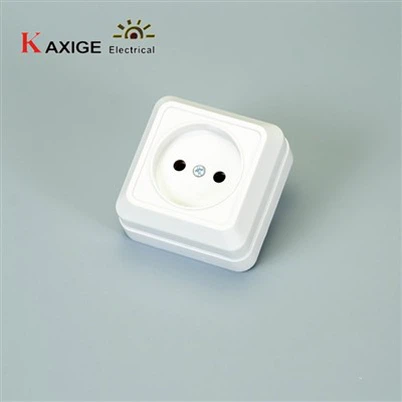
Loose Socket and Switch? 2 Simple Repair Methods You Can Do Yourself
Leave a message
In daily life, many households encounter the problem of loose sockets and switches: the panel wobbles when pressing the switch, the plug easily falls out when inserted, and even slight abnormal noises are accompanied. Many people think this is a trivial issue that is harmless, but they do not know that there are hidden dangers behind it-looseness can lead to poor contact, which in turn causes heat generation and electric arcs, and may even induce fires in severe cases. In fact, there is no need to rush to find an electrician. Mastering 2 simple methods, you can repair it safely by yourself. As a manufacturer with decades of experience in the electrical industry, Zhejiang Honghuo Electric combines production experience to detail the operation steps for everyone.

Before repair, you must keep in mind the core premise: safe power off. Regardless of the size of the problem, first go to the distribution box to turn off the circuit breaker of the corresponding circuit; if you are not sure about the corresponding circuit, it is safer to turn off the main switch directly. After power off, it is recommended to test with an electric test pen or a mobile phone charger to confirm that there is no electricity at all before starting work. This is the lifeline of electrical operations. At the same time, prepare basic tools: insulated Phillips/flat-blade screwdrivers and insulating tape are sufficient. For advanced repairs, a back box repair tool can be prepared. It should be emphasized that whether it is repairing socket and switch electrical or maintaining extension cord with switch, safe power off is the top priority.
Method 1: Screw Fastening Method to Solve Looseness Between Panel and Back Box. Most looseness is caused by loose fixing screws, and the operation only takes 3 steps. Step 1: Remove the panel. Use a flat-blade screwdriver to gently pry open the decorative cover of the socket and switch, exposing the internal fixing screws. Step 2: Check the loose points. Use a screwdriver to try to tighten the fixing screws on the panel. If the panel still wobbles, you need to further loosen the panel screws, take out the functional module, and check the two long screws connecting the module to the wall back box. This is the core fixing point, and it is likely that this place is loose. Step 3: Precise fastening. First, manually screw the screws slightly to ensure thread engagement, then use a screwdriver to tighten them clockwise, following the principle of "alternate tightening diagonally" to avoid the panel tilting due to uneven force. Tighten them without excessive force to prevent plastic parts from cracking. After completion, reset the module, snap back the decorative cover, and power on for testing. This method is also applicable to the loose panel of some extension cord with switch, which can be repaired by referring to the above steps.

Method 2: Copper Sheet Correction Method to Solve Loose Plug Clamping in Jacks. If the panel is firmly fixed but the plug still falls out easily, the problem lies in the conductive copper sheets inside the socket. Long-term plugging and unplugging will reduce the elasticity of the copper sheets and increase the gap, making it impossible to clamp the plug tightly. The operation steps are as follows: After power off, remove the panel and functional module, then use a screwdriver to gently pry open the buckle of the socket inner shell; find the loose copper sheet, and gently pinch it towards the middle with needle-nose pliers. The force should be such that there is obvious resistance when inserting the plug. Do not use excessive force to cause the copper sheet to break; after pinching, insert the plug to test the tightness. After reaching the standard, snap back the inner shell and reset the module and panel in the reverse order of disassembly. If the copper sheet is severely oxidized or deformed, it is recommended to directly replace it with a new socket to avoid potential safety hazards after repair. When repairing socket and switch electrical, it is crucial to check the condition of the copper sheet, as it directly affects the safety of electricity use.
It should be noted that if looseness, heat generation or abnormal noise still occur after repair, or if the back box is severely damaged, the line is chaotic, etc., you should stop using it immediately and contact a professional electrician for processing. To fundamentally reduce the problem of looseness, the key is to choose reliable quality products. Zhejiang Honghuo Electric Co., Ltd. is located in Lishui, Zhejiang. Since its establishment in 1985 (formerly Zhejiang Huada Electrical Equipment Co., Ltd.), it has always focused on the R&D and production of European standard sockets, switches and plugs. The company covers an area of 23,000 square meters, is equipped with advanced production equipment such as injection molding machines and punch presses, and controls quality through strict testing processes. It has obtained many authoritative certifications such as CCEE, CCC, ISO9001, and CE. The product's fixed structure design and long-term elasticity of copper sheets have been repeatedly optimized, fundamentally reducing the risk of looseness during use. Whether it is socket and switch electrical or extension cord with switch, the company's products are designed with safety and durability in mind.
Electrical safety is no trivial matter. It is recommended to regularly check the sockets and switches at home and deal with looseness in a timely manner. The above two methods are simple to operate and low in cost, suitable for most common looseness situations. If you encounter difficulties during operation or need to learn about the purchase knowledge of high-quality sockets and switches, you can follow Zhejiang Honghuo Electric. We will continue to share professional electrical knowledge to escort the safety of household electricity use.