10A vs 16A Wall Switch: Key Differences & Safety Precautions
Leave a message
In daily electricity usage scenarios, 10A wall switch and 16A wall switch are the two most common specifications. However, many people often ignore the differences between them and use them randomly. Little do they know that choosing the wrong socket and wall switch specifications may not only render the equipment unusable, but also pose serious safety hazards such as fires and electric shocks. As a manufacturer with 38 years of experience in the electrical industry, Zhejiang Honghuo Electric Co., Ltd. combines its production and R&D experience to provide a detailed analysis of the core differences and safety precautions.

Firstly, the rated current is the core difference between the two, which directly determines the bearing power, and this is also the most essential difference. The socket corresponding to the 10A switch has a rated current of 10 amps. According to the power formula P=UI (household voltage 220V), its maximum bearing power is about 2200 watts; the socket corresponding to the 16A switch has a rated current of 16 amps, and the maximum bearing power can reach 3520 watts. Simply put, 10A switch and its matching sockets are suitable for small-power household appliances, such as mobile phone chargers, desk lamps, computer hosts, etc.; 16A switch and its matching sockets are aimed at high-power equipment such as air conditioners, electric water heaters, induction cookers, etc. These equipment have large current when starting, which cannot be borne by 10A switch and its matching sockets, and are prone to line overload.
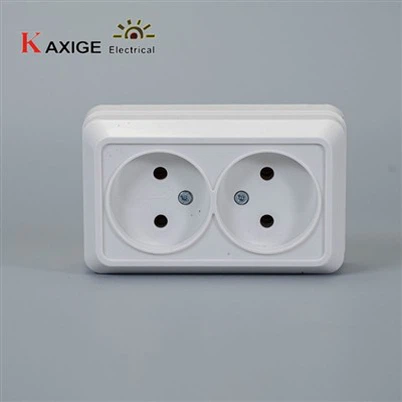
Secondly, the appearance size and jack spacing are different, and the sockets corresponding to 10A and 16A switch are not universal. The jack spacing of the socket matching the 16A wall switch is larger, and the plug blades are thicker, aiming to increase the contact area and reduce the heating risk when current passes through; the jack spacing of the socket matching the 10A is smaller, and the plug blades are thinner. If the 16A plug is forcibly inserted into the 10A socket, it will cause poor contact between the plug and the socket, generate electric sparks, and long-term use may burn the socket contacts and even cause short circuits. In addition, 16A switch is usually equipped with thicker internal wires and high-temperature resistant shells, and its matching sockets also adopt the same high-standard design to further improve safety performance.

The safety hazards of choosing the wrong 10A switch or 16A switch and their matching sockets are far more serious than imagined. If 10A switch and its matching sockets are used to connect high-power household appliances, the socket may heat up and the shell may deform in a short time; in the long run, it will lead to line aging and insulation layer damage, causing short-circuit fires; if small-power equipment is inserted into the socket matching 16A switch, although there will be no immediate problems, due to the mismatch of contact area, it may lead to unstable current, damage the internal components of the equipment, and at the same time, there is a risk of electric shock caused by poor contact.
As an enterprise focusing on the R&D and production of European standard switches and sockets, Zhejiang Honghuo Electric Co., Ltd. always puts safety first. The company is located in Lishui, Zhejiang, covering an area of 23,000 square meters. It is equipped with advanced production lines such as injection molding machines and professional testing equipment. The products have passed multiple authoritative certifications such as CCEE, CCC, ISO9001, and CE. From raw material selection to finished product testing, the quality is strictly controlled throughout the process to ensure that each 10A wall switch and 16A switch and their matching sockets can meet the safety bearing requirements.
Finally, we remind you that when choosing 10A wall switch or 16A switch and their matching sockets, you must follow the "power matching" principle and do not mix them randomly. During installation, high-power household appliances should use 16A wall switch and its matching sockets independently, and be equipped with independent circuits; in daily use, avoid connecting multiple high-power equipment to one socket at the same time. Paying attention to the matching between the specifications of wall switches and sockets and electricity demand can avoid safety risks from the source and protect household electricity safety.